
Yesterday I visited Easter Aquhorthies stone circle in Aberdeenshire. Constructed during the late Neolithic to early Bronze age (around 3000 BC to 2000 BC), this is one of the best-preserved recumbent stone circles of the northeast. It is also one of the oldest, though there are older; the Loanhead of Daviot stone circle is thought to be around 5000 years old- older than the Egyptian pyramids!
I first visited this stone circle in April 2023, though then it was an overcast and grey day, a bit gloomy and foreboding. Yesterday was glorious, the sun was shining and there was a gentle peacefulness in the circle. I was surprised that on such a beautiful day, and a Saturday at that, there was only me at the site.
Taking advantage of the solitude, I experimented with the site’s archaeoacoustics.
Archaeoacoustics explores sound and music of the past and studies soundscapes of architecture and natural environments for an understanding of the cultural, symbolic, and psychological dimensions of ancient sound.
Sitting on the recumbent stone I “sounded” using my voice into the centre of the circle.
Easter Aquhorthies is thought to hold complex acoustic dimensions which may have facilitated a special kind of ritual sound experience. Rather than the sound diffusing out equally into the landscape, the sound was contained and directed to certain places within the circle. It is likely that sound could be heard loudly and in a particular way by those inside the circle. For people on the outside, it would have sounded different; muted, or even silent. This may speak to initiates receiving special and secret knowledge or having initiatory experiences that were not available to all.
I have experienced this phenomenon at other sites.
Yesterday, sounding not words but vowels and other sounds that spontaneously came through me, I felt that I had both entered and was creating a sound sphere of vibration. This field of sound penetrated the circle, interacting with the stones in a magical way.
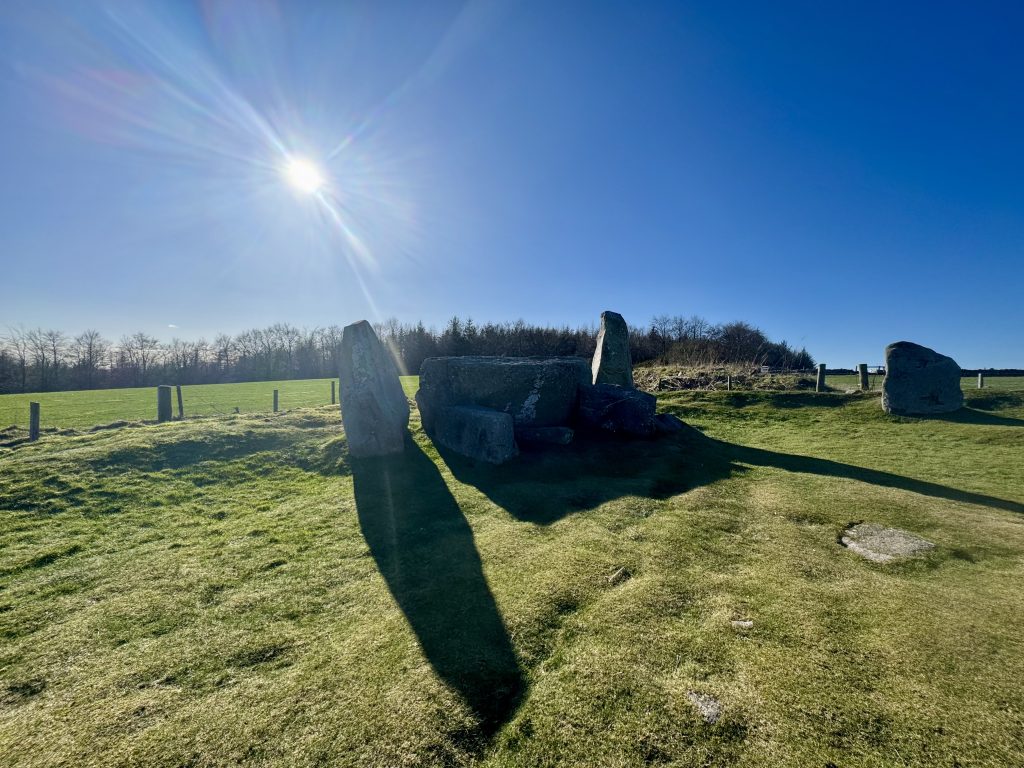
I spent about an hour at the site between 1.30 pm-2.30pm; as it was a bright sunny day, the shadows cast by the flanking stones to the south, southwest of the circle were clear and elongated. Stretching into the circle on either side of the centre where once there would have been a circular cairn, shadows from the flanking stones resembled a pointer on a dial. From the centre (marked by a small stone slab) the two shadow pointers were at 11 and 1. As the sun moves across the sky, I imagine that both shadows intersect at the central point depending on the time of year.
It is possible that the ancients considered the flanking stones, that is the two large stones on either side of the horizontal recumbent stone, as male and female. There does not appear to be a consensus regarding which stone is male and which is female, though for me the left stone (looking at the recumbent from the central point) is female, and the right stone is male. This polarity is most obvious at another nearby recumbent stone circle known as Loanhead of Daviot. Here the right stone is unmistakably phallic.
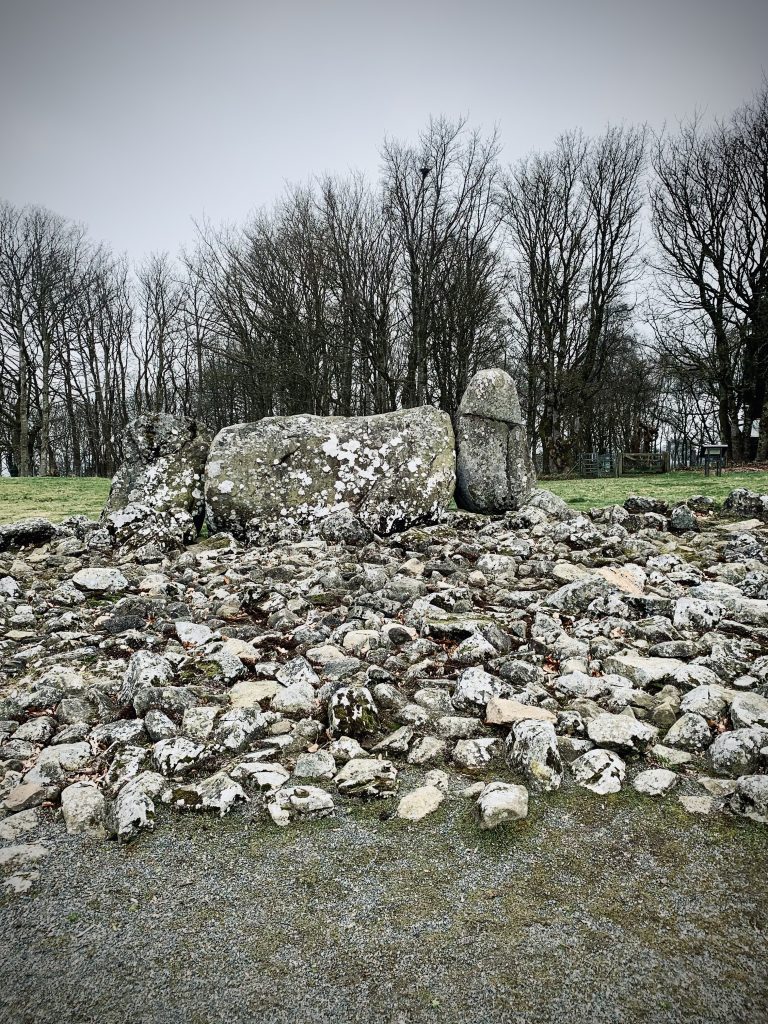
The huge recumbent stone is always considered female.
When the two shadows cast from the flankers meet at the central point, symbolically speaking this can be read as a magical union of male and female, a hieros gamos, illustrated on the landscape, created by the stones, the season, and time.
I placed the shadow of my own head on the central point as I vibrated sound into the circle.
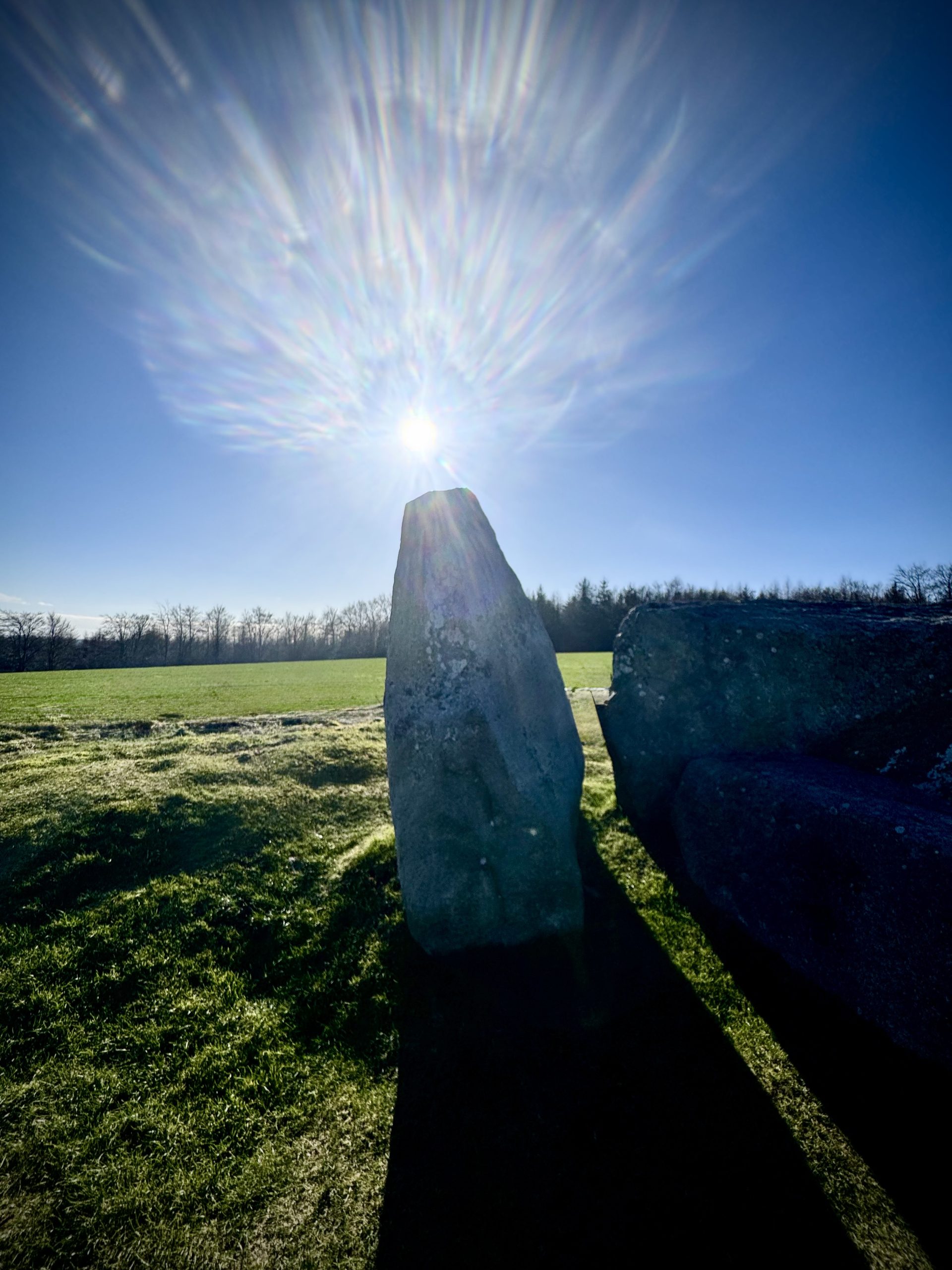
At south, southwest, the sun shone bright in the sky above the recumbent stone in between the flankers. The stone on the left (which I felt is female) was penetrated by the rays of the sun so that the light appeared to bend through the stone, bringing the stone to life. On my phone camera I captured the light rays from the sun fanning out in soft, bird-like or angelic patterns above the stone.
I’d not thought much about it at the time but later when I checked the astrology, I saw that Venus and Mercury were conjunct at 22 ° Pisces; the Sun and the lunar north node were conjunct at 9 ° Pisces.
Astro-symbolically then, the goddess (Venus) was being transmitted by the messenger of the gods (Mercury). And that’s certainly how it felt, particularly as at times I was chanting goddess sounds into the space.
Venus and Mercury are the two planets most associated with sound and vibration.
Venus: The planetary frequency of Venus is 221.23 Hz, believed to resonate with themes of love, balance and harmony.
Mercury: As the planet of communication and speech, it was discovered in 2023 that “whistling” or “singing” plasma waves emit from Mercury’s magnetic field. In the context of Hans Cousto’s “Cosmic Octave” theory, Mercury is assigned a frequency of 141.27 Hz.
My trip was not planned; I was in the area for work and had not expected to be free that day, let alone visit a sacred site. But I have found that that’s how these things go. Planning is good too, though there is something wonderful, mystical, and spirit-aligned when things come together in cosmic order. Maybe it’s our personal “daimon”, leading us to exactly where we need to be; aligning us with places, memory, and spirit that opens us to planetary influence, directing our path in the cosmic dance of existence.
I am planning “Way of the Serpent” astro-visits to this and other sacred sites in Scotland this year. If you would like to join me, please PM your e-mail and I will keep you informed of the details.
karen@gnosticwoman.com


