
Ereshkigal Speaks
Share this post:
Share on facebook
Share on twitter
Share on linkedin
If you grew up in a home that was infected with intergenerational trauma, shame, abuse, narcissism, or any other emotional pain and/or cruelty, you are likely familiar with some of the terms currently used in psychology to describe these experiences.
You may have identified yourself as a broken person based on having a particular set of early experiences due to this infection. For example, you may identify as the family scapegoat, the lost child, or the parentified child.
No doubt if this is you your adult life has been marred by the effects of developmental or complex trauma. There is also a strong possibility that you have spent your life trying to understand what happened and that this has led you on a path of self-discovery. Perhaps you have attempted to reclaim yourself and free yourself from internalised false identities. As an empathetic and/or sensitive person you may also have oscillated between feeling deep compassion for the people who hurt you as you recognised that they too were hurt. Through this compassion you may have neglected to truly feel and acknowledge what happened to you.
Maybe you were lost to yourself for many years through addiction, self-destruction or sabotage. It could be that you developed toxic patterns yourself and behaved poorly toward others. And of course, there is a chance that you continue to experience the unhealed trauma through your adult relationships, friendships, workplace, and life circumstances.
Why some are called to this path and others are not is a mystery.
Today on my run I had the thought, if we are brave enough to face the parts of us that are broken (or that we believe are broken), we can heal and become whole again.
I thought of Inanna’s descent into the underworld to meet with her dark sister Ereshkigal who is writhing in pain, and whose insides and outsides hurt. Psychologically, the pain that we feel on the inside causes pain on the outside. Inanna’s resurrection happens and her freedom is won when two tiny creatures sent by the god Enki (wisdom) not only witness but feel the pain of Ereshkigal.
And it’s like this for us too. For those of us who have experienced trauma in childhood and have lived from the wound, what is needed is compassionate witnessing. In the myth Ereshkigal is very specific about what parts hurt; she specifically names her insides, her outsides, her heart, her liver. The two tiny creatures, the kugarra and the galatur, explicitly feel her pain with her and name these things too.
When Ereshkigal realizes the two creatures are genuinely empathizing with her rather than judging or trying to fix her pain, she feels deeply relieved and grateful, offering them what they came for – the corpse of Inanna, thus leading to Inanna’s resurrection.
The key inherent in the myth is that if we judge or try to fix the pain without feeling it and witnessing it, the pain continues, and we are forever cut off from our shadow.
Some of us may have feared that in allowing ourselves to fully feel the pain we will be overwhelmed by it. We may also feel a sense of betrayal against our parents and families for naming it and telling the truth of what happened.
An important part of recovery then is finding the right person or people to share your experience with and possibly to work with. I don’t think this is an easy task and there are no quick fixes. This part of the process can take years, decades even, and may sometimes feel hopeless. But it is not hopeless, it is the path to wholeness, to awakening and to finally retrieving the split off parts of the soul from the underworld (the unconscious).
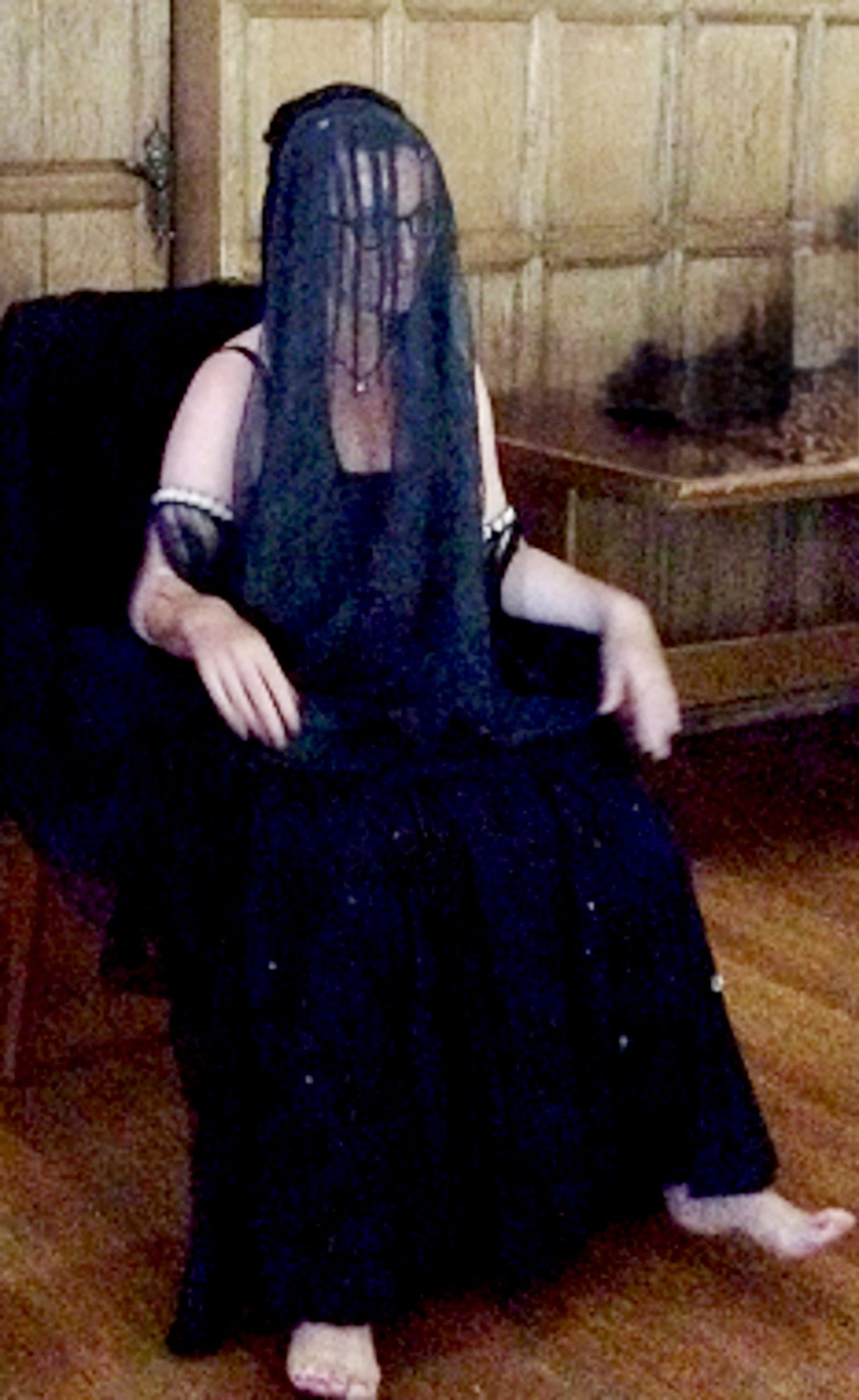
This image is of me playing the role of Ereshkigal in a creative project by one of my cohorts on the Myth, Cosmology and the Sacred Masters programme at Canterbury Christ Church University. It was an enactment of the Descent of Inanna. I spoke Ereshkigal’s words as she writhed in pain, complaining about her insides, her outsides, her heart and her liver. I also did a great deal of loud moaning and groaning that surprised not only me but everyone else in the room; the sound seemed to come from a deep cavernous place inside of me but also from outside of me, from the collective unconscious. It was quite terrifying but also liberating.
This took place somewhere between the first and second hit of Pluto on my Capricorn Sun in the summer of 2017.
Curiously, the person who played Netti, the chief gatekeeper of the underworld who strips Inanna of her vestiges as she makes her descent, was my partner. As it transpired, the dynamics of the play– me as Ereshkigal, and him as the gatekeeper of the underworld, mirrored many of the dynamics of our relationship and my descent into my own unconscious as Pluto transited my natal Sun.
Though it was not a conscious intention of the play, this ritual enactment was not only cathartic but, in some ways, also powerfully prophetic.
Join the mailing list for news, updates and promotions.

- Copyright © 2025 Gnostic Woman

