
Mary Queen of Heaven: Blessed is the Fruits of Thy Womb.
Share this post:
Share on facebook
Share on twitter
Share on linkedin
Today, 15th August is the Feast of the Assumption of the Virgin Mary, also known as the Dormition of the Mother God, celebrating the falling asleep “death” of Mary and her being taken up to heaven.
On my run along the hedgerows this morning I was moved and delighted to see the generous bounty of fruits and berries graciously offered by the trees and shrubs.
Sadly, I thought how most of them will fall and wither, unappreciated, forgotten and unrevered, while most people will buy fruits from supermarkets in plastic containers.
Beyond the liturgical calendar or the church year, beyond Hebrew literature or any other monotheistic context, pre- Christian cultures celebrated the “fruits of the earth” at harvest time and equated the fertile earth with a pregnant Mother goddess.
To the ancient mind, the soil is the womb, harvest is the birth, and the earth Mother is the eternal goddess and Queen of Heaven & Earth.
At the council of Ephesus in 431, it was declared and dogmatically defined that Mary was Mother God, and that it was correct to call Her Theotokos, “God Bearer”.
In 1950, Pope Pius XII declared the Assumption of Mary official dogma of the Roman Catholic Church which teaches that the Virgin Mary “having completed the course of her earthly life, was assumed body and soul into heavenly glory”.
From the point of view of the pre-Christian mind, the fruits of the earth were already imbued with God, or more specifically goddess. There was no end to the earthly life of the eternal mother and therefore no need to assume her into a heaven that was separate from the earth.
The Assumption of Mary happens 9 days after the Transfiguration of Jesus.
Transfiguration (August 6) is a moment of Jesus showing his divine light while still alive on Earth. It reveals the promise of resurrection.
The Transfiguration of Jesus aligns symbolically with the harvest, specifically through the ancient tradition of offering the first fruits of the summer and autumn crops.
Christian tradition ties the August 6 Feast of the Transfiguration to blessing the earth’s first yields, mirroring how Christ’s glorified body foreshadows the ultimate renewal of all creation.
Like the corn, Jesus will be cut down and resurrected as the risen Christ.
The mysteries of renewal transposed onto the son of God, slowly overshadowed the ancient rituals dedicated to the Earth Mother Demeter and her daughter Persephone.
The Eleusinian Mysteries were practiced for almost 2000 years before they were officially shutdown in 392 CE. The Greater Mysteries lasted for 9 days every autumn (the exact time frame between the Transfiguration and the Assumption).
Across the ancient Mediterranean and Egyptian worlds, mid-August marked a period of major religious festivals, harvest celebrations, and seasonal transition.
Embedded in ancient agricultural sacred calendars, it was a time to honour the goddesses associated with fertility and renewal.
“Hail, Mary, full of grace, the Lord is with thee. Blessed art thou amongst women, and blessed is the fruit of thy womb, Jesus.”
Long before the phrase “Blessed is the fruits of thy womb” was written down in a monotheistic context, pre-Christian cultures universally celebrated the “fruits of the earth” at harvest time as an honouring of the fertile earth and the Mother Goddess.
The Earth as a Womb, and the Harvest as a Child.
In almost every pre-Christian European and Near Eastern tradition, human pregnancy and agricultural harvest were treated as the exact same mystical process.
The Christian narrative absorbed and mirrored these ancient agricultural archetypes.
The title “Queen of Heaven” is most famously used by Catholics and Orthodox Christians to honour the Virgin Mary. However, thousands of years before Christianity, it was the title given to several major pagan fertility goddesses across the Ancient Near East and Mediterranean.
In ancient Gaelic mythology, the pre-Christian harvest festival of Bron Trogain (the precursor to Lughnasadh/Lammas) translates to “the earth sorrows under its fruits”. It referred to the painful “labour” of the Earth Mother as she gave birth to the autumn harvest.
The Romans worshipped Terra Mater (Mother Earth) and Ceres (goddess of grain and agriculture). During the Cerealia festival, the “fruits of the earth” were blessed and celebrated as her direct offspring.
In the ancient autumn festival of the Thesmophoria, women celebrated the fertility of both the human womb and the soil simultaneously, offering fruits and seeds back to the earth.
The ancient Egyptian goddess Isis was associated with the fertility of the earth and the life-giving nature of the Nile.
Pre-Christian statues of Isis cradling her divine child, Horus, was a visual template used by early Christian artists to depict the Virgin Mary cradling the infant Jesus.
I don’t feel this piece is a feminist’s polemic against Christianity. Rather it is a lamentation over modern culture’s demotion of the goddess in Her role of Creatrix and Mother; Her mysteries forgotten and subsumed into a religion in which She has been forced into a subordinate position.
It is also a longing rising in me and a reminder to get out into Nature, reap the fruits of Her womb and envelope myself in Her most generous and loving embrace at this time of year.
Words Karen Mullen Smith ©
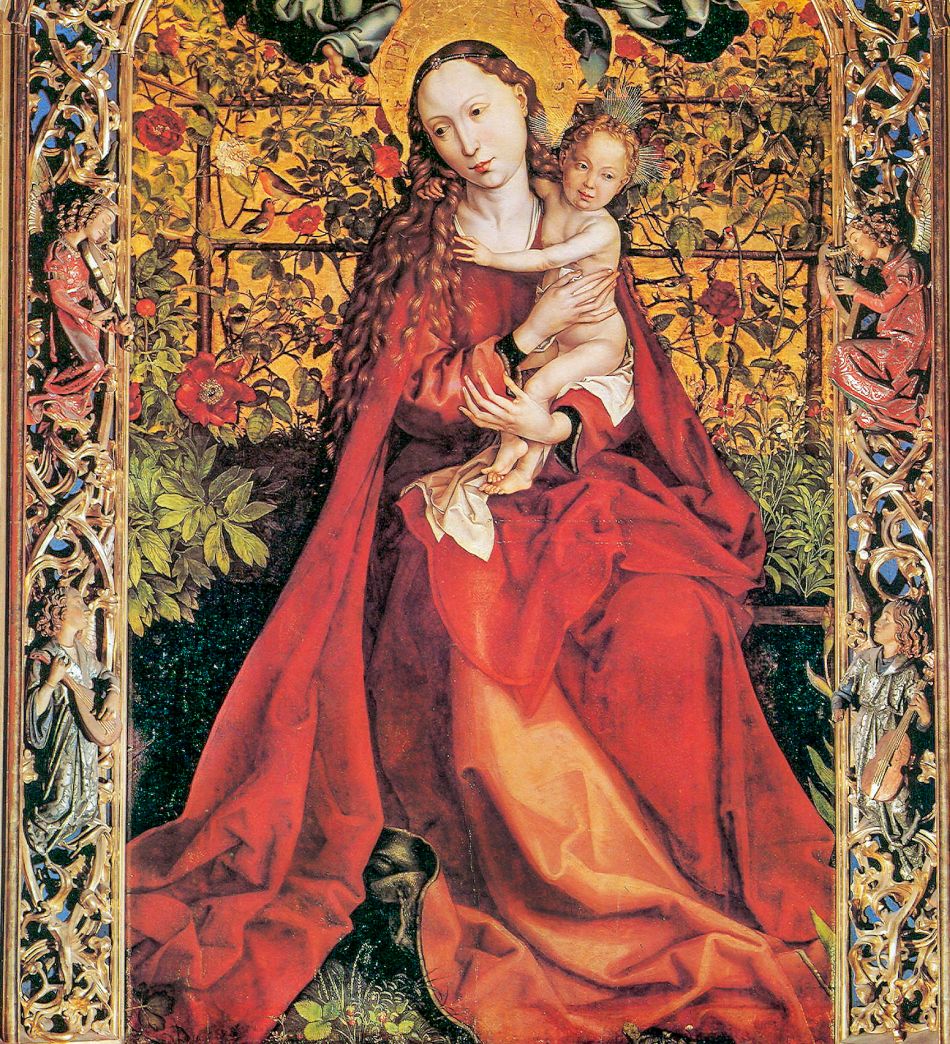
Image: Madonna of the Rose Bower, painted in 1473 by the early German master Martin Schongauer.
Join the mailing list for news, updates and promotions.

- Copyright © 2025 Gnostic Woman

