
The Dreaming
Share this post:
Share on facebook
Share on twitter
Share on linkedin
I have consciously been working with my dreams (and sometimes the dreams of others) for twenty years. There were dreams before that, some of them “big dreams” that I wrote down, but as a systematic practice, I’ve been journaling my dreams consistently for two decades. That means I have accumulated a lot of dream journals. Many of the dreams were documented but not “worked” with. They remain translated into words, sometimes scrawled into beautiful journals, left to collect dust on shelves of rented rooms.
I have burned many journals too. Partly I regret this but my reasons for doing so at the time were valid. I moved around a lot, had many addresses and lived in different places. For years I had few possessions. My biggest items were cases and bags full of journals that I hauled around from place to place. Eventually the journals began to feel like a burden, especially when I thought about trying to find the time to read them and “do something” with them. Taking time to process the dreams and to write them already demanded a lot of me and sometimes it felt that the unconscious had too tight a grip on me… as if I was captive in my own underworld story.
There is a point on the Camino Santiago known as the Cruz de Ferro. It is a simple iron cross on top of a tall wooden pole on the highest point of the French Way; it is a place where pilgrims put down their burdens. Often the burdens are represented by a symbolic stone although people place other, more literal things there too. I placed my current journal. I wanted to walk the Camino as presently as possible; for that time, I wanted to feel free from the binds of my unconscious. To walk 1000 KM, one cannot remain tied to the “Spirit of the Depths”, there are rooms to find, meals to eat, maps to follow, passports to get stamped, and people to talk to (unless silence is part of the pilgrimage). One needs to keep one’s wits about them; there are stray dogs and wolves in the mountains. And in human form there are opportunists of all kinds.
It was dreams that led me to practice shamanism in 2005. I was chatting with a house mate and telling him that my dreams seemed to have their own topography and symbolic language and that I was learning to understand them. Dreaming about certain people, places, or animals conveyed meaning to my conscious mind and I was able to work with the symbolism that I- a less rational I- assigned to them. In this way I built a “dreamscape” that I was learning to navigate. My friend recognised something “shamanic” in what I described and suggested I go and get trained. So, I did.
I could have worked even more deeply and “shamanically” with my dreams and journeys however the “real” world of materia, relationships, and what Jung called the “Spirit of the Times”, does not always leave the psychic space necessary to make a conscious descent to the ‘Spirit of the Depths” as Jung himself had done. In Jung’s case, he had a devoted wife who was at the time one of the wealthiest women in Europe; Emma Jung ran a comfortable and established home. Jung also had a mistress, Toni Wolff with whom he was in a 40-year relationship. By her own definition Toni was the “Hetaira” and the “Medial” woman aka, the archetypal companion, lover, and muse who inspires individual relationship and psychological awakening; and the archetypal mediator, medium, and psychic who senses and voices the unconscious collective atmosphere.
Furthermore, Jung had built himself a tower to which he could retreat and be perfectly alone to make his descents, safe in the knowledge that in his home and personal life was the unshakeable love and devotion of two powerful women-one the mystic, one the mother… although both were brilliant analysts in their own right. My feeling is that each of these women inspired and contributed to Jung’s work more than has been realised.
Who has the time and resources today to devote themselves entirely to their inner world? Not many. Artists, modern mystics, poets, musicians, and those belonging to religious or spiritual orders perhaps, and still, theirs is not an easy path. It is also worth reflecting on gender disparity and the ability to take time out to go inward, to be with the self and connect with the unconscious. Only the other day I met a female friend I’d not seen for a while. When she asked how I’d been I told her that I’d been in an interior space, still grieving the untimely death of my mother, and spending lots of time alone. Her response was one that I’ve heard often over the years: “Great if you can do that”. I knew what she meant. I recognise the ability to “go in” as a privilege that not everyone gets, and yet going in comes with a cost, and sometimes the price tag is heavy.
Perhaps some of us do not have a choice and the best we can do is learn to somehow live with and manage this calling… become walkers of the worlds… modern day shamans and maybe extend the meaning of our dreams beyond ourselves into the social spheres and the collective dreaming.
The reason I am writing about dreams now is because in the past year my relationship with my dreams has reached another level. I am “working” with them in a new way, and the more I attune to them the more they reveal themselves to me. I agree with Freud, that dreams truly are “the royal road to the unconscious”.
Dreams never cease to amaze me in their complexity, layered texture, obscurity, literalism, playfulness, and mastery. Dreams are the AI of the psyche, only they are organic (OI), a natural powerhouse and memory bank existing only for us (with tentacles to the collective unconscious), our inner working, the mothership of our psyche, our instinctual and intuitive compass, our inner knowing and path to gnosis. They are the keepers of the sacred flame within.
Going forward I intend to work a lot more with dreams in a similar vein to how I work with myths. What meaning can be derived from our dreams for ourselves and for the collective?
Stay tuned for more dream explorations.
Words: Karen Smith, 2026 ©
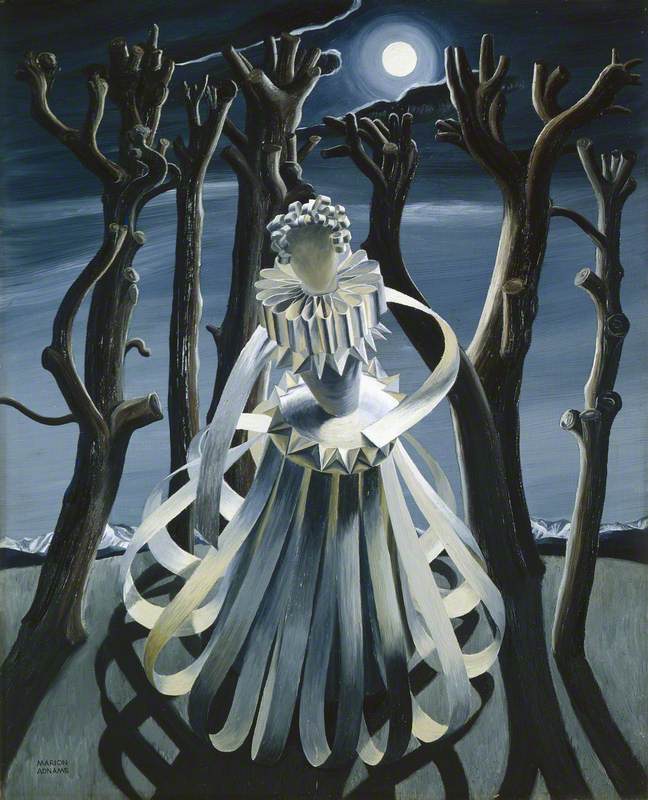
Image: L’infante égarée, Marion Elizabeth Adnams (1898–1995)
Join the mailing list for news, updates and promotions.

- Copyright © 2025 Gnostic Woman

